
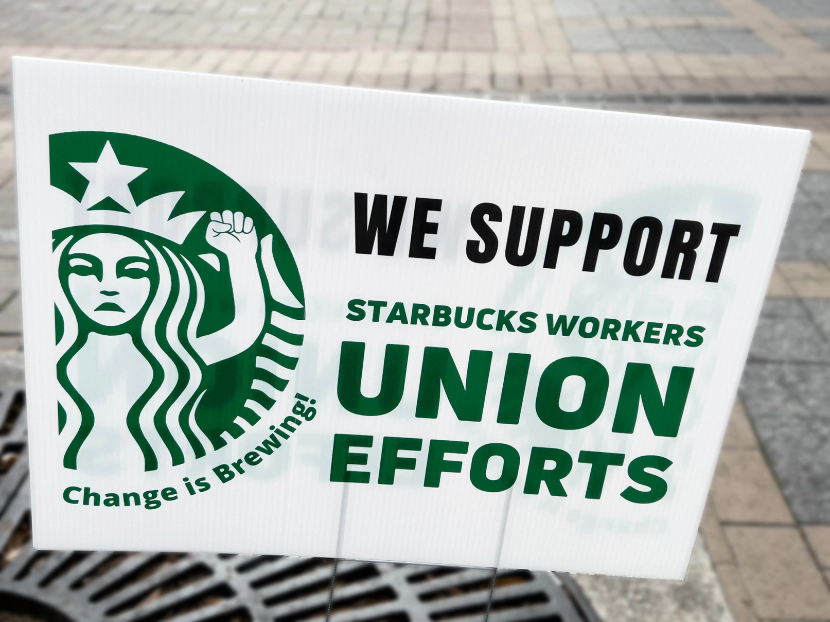
In December of 2021, Starbucks workers in Buffalo, New York voted to unionize their store, setting off a chain reaction that ignited the labor movement in the United States across the service sector.
At the time, it was the only Starbucks unionized in the country. There are now over 700 unionized Starbucks stores in the United States.
But a quick glance at the unionization map reveals the elephant in the room – why are there practically no unionized Starbucks in the North Bay?
John Logan is a Professor and the Director of Labor and Employment Studies at San Francisco State University. He was also the former research director at the UC Berkeley labor center.
“There’s never been a company, I would say, in the history of the NLRB that has committed as many illegal practices as Starbucks did during the first two years of that campaign,” said Professor Logan.
According to a press release from Starbucks Workers United, “Previous decisions from ALJs in September 2023 and July 2024 addressed Starbucks’ unlawful pattern of promising and then granting benefits to non-union employees that it withheld from unionized employees, including: raises, access to credit card tipping, relaxed dress codes, [and] faster sick leave accrual rates.”
Fairfield hosts the only unionized Starbucks in the North Bay inside the city’s largest shopping mall. In December of 2023, the Starbucks on 125 Petaluma Blvd voted to Unionize 12-0.
In 2025, it was one of six Starbucks locations closed in the North Bay.
The National Labor Relations Board found Starbucks guilty of over 500 labor law violations, ‘making it the worst violator in modern history.’
Besides the company’s anti-union strategies, Professor Logan offered insight into what other factors might have resulted in less unionized stores in the North Bay.
“The North Bay is just less dense, the stores are further apart,” said Logan. “That wasn’t the only reason, because there were other parts of the country that was probably true where they did organize.”
Another possible reason? Age demographics.
“One very noticeable thing was most of the leaders of the Union were all young workers,” said Logan, “I don’t mean like 16 [or] 17 year olds, but they were mostly people in their twenties.”
He said that while there were unionized stores with older workers in their forties and fifties, they were less likely to be the activists in the campaign.
“You had the first ever union victories at Starbucks, Amazon, Trader Joe’s, REI, Barnes and Noble, Apple retail, Chipotle, – I could go on and on. The first time unions have won any of those places, all of the campaigns were led by young workers.”
Logan emphasized that young workers are some of the most energized about labor issues as they face harder economic expectations.
“I think [they] are sort of politicized differently and are more skeptical about the sort of negative aspects of U.S style capitalism than previous generations,” he said.
“[From] a North Bay angle, why didn’t this take off? Is the organizing wave over? I think it is over, but I think the underlying conditions that gave rise to it are still there,” said Logan.
“How are you going to fight back against this sort of oligarchy in America? These corporations are increasingly powerful, rich, they control the money, they control the political power. How are you going to fight back against that? There’s only one way. You organize the workplace.”
Aidan Hall-Guzmán is 26-year-old shift leader at Starbucks in Santa Cruz. His store won the union election 11-2, despite Starbucks’ anti-union tactics, including spreading rumors and favoring anti-union employees.
“Corporations in general use the exhaustion of the working class as a way to prevent them from collective action,” said Aidan Hall-Guzman, “In a place where unions have been kind of demonized and misrepresented in the United States, I feel like that propaganda is less and less effective as people are hungrier and hungrier.”
While not in the North Bay, he said Santa Cruz’s density played a role in their stores’ unionization win.
“Santa Cruz is the densest area when it comes to organized stores, so we had a lot of support from other baristas who have gone through this process – people who can talk to workers from a place of more experience,” he said. “I would say ultimately it was the camaraderie of baristas in the area, but also the camaraderie of baristas in our store that really got us our win.”
He also said Starbucks does a lot to frame organizing any criticism of their upper brass, as causing negativity, or rocking the boat.
“As baristas, our job is to almost do the opposite – to provide comfort for people on their way out into the world,” said Hall-Guzmán, “But I don’t think it’s negative to stand up for what’s right.”