
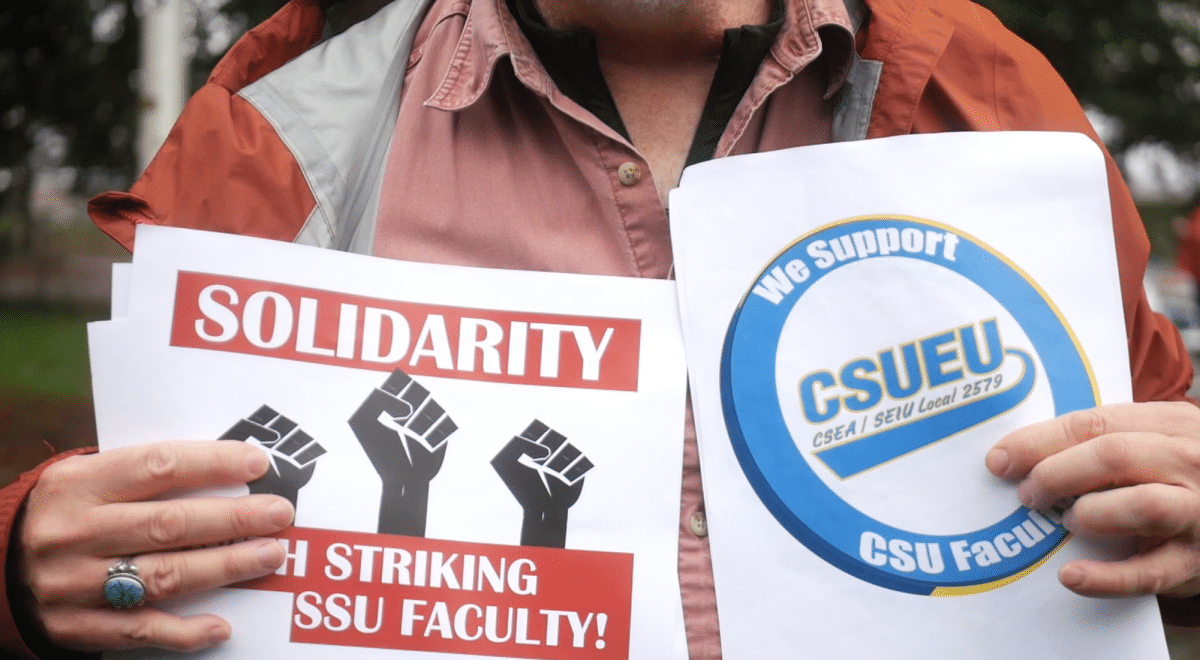
From April 2023 to February 2024, I was one of many students and organizers who took part in an effort to allow student workers across the California State University (CSU) system to become members of the CSU Employees Union (CSUEU). In the lead up to the vote that successfully secured representation rights for thousands of students, I was a member of the campaign’s Organizing Committee at Sonoma State University. As a volunteer, I spent hours canvassing, phone banking, sitting in on Zoom meetings, and, whenever I could, encouraging my coworkers in Culinary Services (where I worked at the time), to vote in favor of unionization.
The experience was quite exciting. We were making history, after all; CBS News reporter Sade Browne, in an article she wrote after the vote, pointed out that our efforts had led to the formation of “the largest union of undergrad student workers in the nation.” It felt invigorating to be a part of a community with a shared sense of purpose, who understood the importance of collective action in the working world and were willing to fight for it. At the same time, however, the endeavor was eye-opening and humbling, sometimes even frustrating. Ultimately, though I have zero regrets and would gladly do it all over again, my view of labor and labor unions was forever reshaped.
According to a February news release by the U.S. Department of Labor Bureau of Labor Statistics, “the [percentage] of wage and salary workers who were members of unions […] was 10.0 percent in 2025.” The document also tells us that “[in] 1983, the first year for which comparable data are available, the union membership rate was 20.1 percent,” meaning that the union membership rate in the United States is slightly below half of what it used to be a little over forty years ago. This is not good news.
The evidence is clear— it shows us time and time again that union membership is beneficial to workers. According to the progressive nonprofit Economic Policy Institute (EPI), “On average, a worker covered by a union contract earns 12.8% more in wages than a peer in a nonunionized workplace (EPI 2025b). Further, in places or industries where unionization is strong, unions also boost wages for nonunion workers by effectively establishing higher standards.” What’s more, the EPI also asserts (based on reputable sources which they cite in their release on the matter) that unions “improve the health and safety of workplaces by providing health insurance and paid sick time, requiring safety equipment, and empowering workers to report unsafe conditions without fear of retaliation (McNicholas et al. 2025).”
Union membership is crucial in seeking recourse in the face of injustice and exploitation; because of this, I believe it’s important for me to share some of what I learned here, so that up-and-coming organizers and activists know what to expect.
The greatest challenge that I faced when spreading the word about both the vote and the prospect of unionization was that a substantial portion of the people I interacted with were inherently skeptical of the whole idea. While they often didn’t express this skepticism directly, I noticed that their tone and demeanor would, in some cases, shift pretty quickly once the word “union” was said aloud. They’d become hesitant, apprehensive, and occasionally, resistant. There were some situations where I felt like the workers I spoke to genuinely wanted nothing more in that moment than for me to go away, like I was a pest of some kind instead of a fellow student employee of the CSU, trying to bring to their attention something that could significantly better their experiences in the workplace.
I don’t bring this up to air my personal grievances with a few random people— I know I’m not some high-and-mighty genius for believing in unions, and to this day I’ve made it a point to never look down on those who were unreceptive to the information I brought them. There’s a reason for that; it’s the same reason why getting workers unionized in the United States is an uphill battle, and will be for the foreseeable future:
In a hypercapitalist society where a prevailing attitude among large swaths of the population is that hard work will lead to personal prosperity, and where, from birth to death, someone is constantly trying to sell you something you don’t need, the idea of banding together to fight for better wages and working conditions can seem like just another scam.
At first glance, the link between advertising and union skepticism may seem like a non sequitur brought up as a “gotcha moment,” but hear me out. Imagine for a moment that you’re a student assistant. In all likelihood, you’re young, busy, and trying to navigate adulthood as best you can. Any previous work experience you have is probably limited to part-time minimum wage jobs, because you had to spend five days a week attending school. Now, in college, you’re working on campus, with presumably much more free time than you had in high school, meaning you can work more hours and make more money. You might have plenty of expenses to worry about—tuition, housing, food, parking, car payments, insurance, etc.—but you have the general sense that you are earning a living by doing what all responsible and able adults are expected to do: having a job.
Now imagine that someone comes up to you and tells you that an effort is underway to form a labor union. It’s possible that, depending on your knowledge of history and politics, you don’t know what a union is, or why unions exist. The organizer may start to talk of the potential benefits of collective bargaining: more sick days, free employee parking, paid time off… depending on where you’re working, all of that might sound too good to be true. You are wary of things that sound too good to be true; wary of the idea that your place in the hierarchy of labor can change in any meaningful capacity. You might even be scared (and rightfully so, given the loopholes that exist for union-busting) that talking about unionizing might get you in trouble with your boss, because the odds of you knowing the labor laws in your area are slim.
“Surely there must be a catch,” you think. “They’re gonna ask for my time, or my money, or God knows what else.” And then, once faced with the possibility of paying union dues or volunteering your time for the cause, your suspicions are all but confirmed. Thus, unions are—in your mind—proven to be yet another money-making scheme that runs on empty promises and pipe dreams. At that point, any further attempts by an organizer to talk to you about the matter feel like unwanted solicitation, no different than a phone call from a telemarketer or a knock on your door from Jehovah’s Witnesses.
I know I took some liberties there, but I’d like to assure you that this little example scenario is based on more than just my imagination. Both during and after my time on the Organizing Committee, I had numerous students express varying levels of annoyance, skepticism, and outright disapproval to me directly. Many of them had already received texts and emails from the union before, sometimes even after they’d asked to be taken off the mailing list.
At one point, early in 2025, months after I’d left my position at the cafeteria to begin my first year as an RA in campus housing, a fellow RA expressed to me that, although they weren’t against the union and hoped that the union would gain more members, “[they would] not be one of them.” This was because they were, in their own words, “personally harassed by union members.” (I was genuinely curious as to what constituted harassment in this case, but I didn’t push the matter any further, because I could tell they were somewhat frustrated with my defense of the union.)
The conversation, while short, had quite an impact on me. After all, I wasn’t talking to a conservative, or someone with a scab mindset; I was talking to a young, open-minded person with decidedly progressive values. The fact that they still saw union outreach, persistent though it may have been, as a form of harassment, raises an important but vexing question for us organizers:
How can we possibly spread the word about an effort to unionize without coming off as pushy, insincere, or deceptive when many American workers have been conditioned to be distrustful of collective action and its promises?
There’s no one answer to this question, but there are some things we could be doing that I believe would make a positive difference.
First, although any method of union outreach can be met with dismissiveness, we must never underestimate the power of in-person, face-to-face interactions with organizers and coworkers. If an organizer is also a coworker, that’s even better, but it’s not a prerequisite. There’s something simple and natural about a word-of-mouth approach that allows for the flow of information in a way that doesn’t feel intentional or strategic.
Plus, showing up for a cause in-person and of your own volition demonstrates that there’s something about that cause that’s worth fighting for. Phone calls, texts, emails, flyers, and social media should obviously still be utilized, but within reason; one communication too many and you’ll find that whatever it is you’re trying to tell someone will go in one ear and out the other.
Second, be mindful of when you approach potential union members. There are pros and cons to all the options. For example, if you go up to a worker who’s on their break, you won’t be interrupting them while they’re trying to focus on their job, but you will be cutting into what little time they have to eat, rest, or relax in the middle of a busy day, which they might come to resent. If you catch them just getting out of work for the day, you’ll have more time to talk to them, but you may also find that they’re eager to get home, catch their ride, meet a friend, etc.
Talking to workers on the clock can be useful, because you’ll know where to find them and they can’t exactly leave. At the same time, I found that this was when the CSU student assistants that I approached were the most distracted, which makes sense. Calling them at home is another option, but there are plenty of people who, especially if they were doing something else beforehand, don’t have the patience for such calls. No method is perfect, but the choice to select one over the others is still important, because some methods might work better in different workplaces.
Third, always treat whoever you interact with as an equal. While educating folks on unions, what they are, and why they’re a good idea is going to be a part of your role, don’t assume that the person in front of you is totally clueless about unions or labor. If they express doubt or disinterest, don’t assume bad faith or a steadfast anti-union worldview. Instead, try to figure out why by asking some simple follow-up questions.
Fourth, and this is crucial— be realistic about unions. Don’t speak about unions as though they’re a magical panacea for ills that only the abolition of capitalism can fix in the long run. If asked, tell the truth: While there’s no guarantee that we as workers will get everything we want, forming a union will give us a fighting chance by allowing us to bargain collectively for higher wages and better working conditions. In all likelihood, there will be significant payoffs to our efforts, as we have seen many times before in other union success stories.
Never let the perfect be the enemy of the good. It’s true; like anything in life, unions come with trade-offs. Contract negotiations can be long and messy, and often involve compromise. Some of your money will go to union dues, and there will be certain rules about what you can and can’t do as a union member. If a strike is called, you will certainly be expected to not cross the picket line, even if you need the work. Your union reps will have your back, but they can’t always get you out of a jam or make things go your way.
Despite this, unions are still worth establishing, protecting, and fighting for. Any union is better than no union, because no matter what the situation, we are always stronger together than we are apart. Part of maturing into adulthood is realizing that any positive change, even if it’s small and takes personal effort, is better than no change at all, or the negative change that accompanies inaction.
A word of advice: Don’t expect the world. Fight for it instead.