SANTA ROSA, Calif. – Nationwide, communities are pushing back on Flock’s usage in their towns – and Santa Rosa is no different.
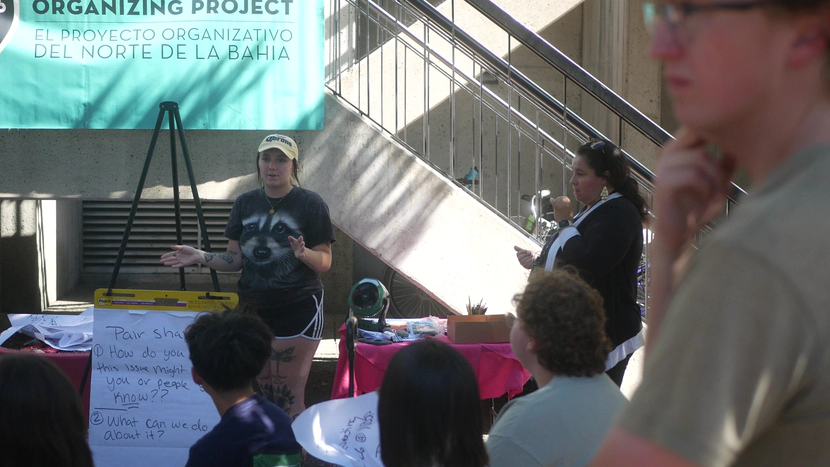
The Civil Liberties Task Force of North Bay Organizing Project (NBOP) held a ‘What the Flock’ teach-in outside Santa Rosa city hall on the city’s use of Flock cameras and Automatic License Plate Readers (ALPRs) on Tuesday, July 14.
The private Atlanta-based company has recently been under scrutiny over what critics argue is the warrantless collection of mass amounts of data. Besides ALPRs, the company produces AI enabled video cameras, drones, and software.
In Santa Rosa, there are now over 120 Flock ALPRs throughout the city.
During NBOP’s presentation, community organizers highlighted an upcoming community forum about the city’s ALPR program with Santa Rosa Police Chief John Cregan on September 17. The session takes place from 6:00 – 7:00 p.m. at the Utilities Field Operations Facility at 35 Stony Point Road.
According to the Electronic Frontier Foundation, “ALPR data is gathered indiscriminately, collecting information on millions of ordinary people. By plotting vehicle times and locations and tracing past movements, police can use stored data to paint a very specific portrait of drivers’ lives, determining past patterns of behavior and possibly even predicting future ones—in spite of the fact that the vast majority of people whose license plate data is collected and stored have not even been accused of a crime.”
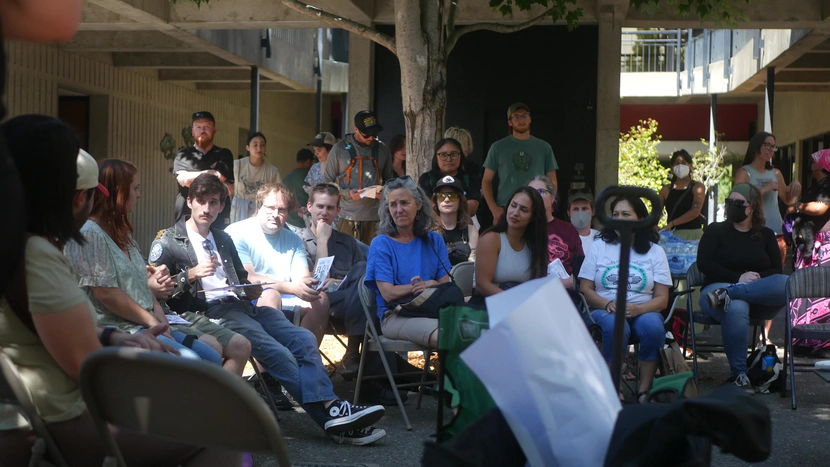
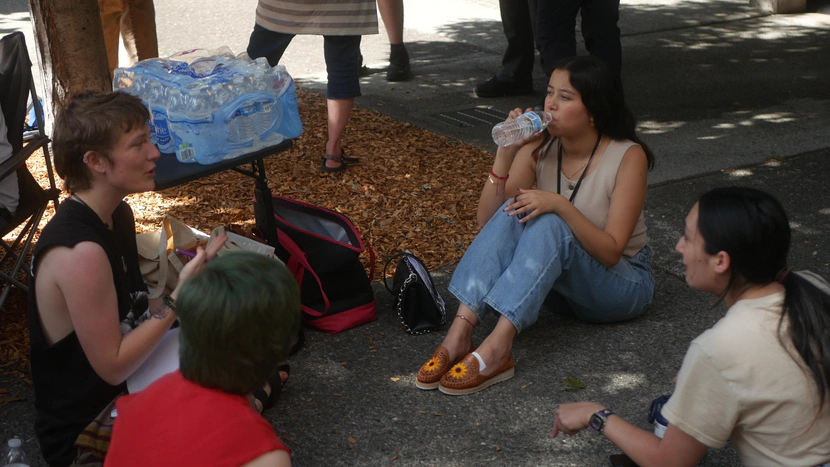
Attendees of Tuesday’s teach-in introduced themselves before breaking into groups to discuss their concerns and questions about the company’s usage of Flock cameras in their community. Over 50 people attended the event.
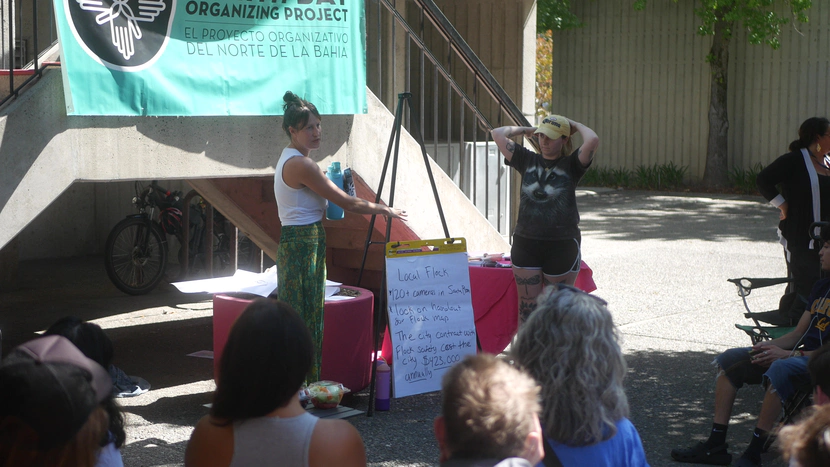
Adrian Baker-Kang, 34, recently moved back to Santa Rosa after 10 years. He saw a post on the Santa Rosa subreddit about Flock, which led him to the teach-in.
He said he was surprised to see the proliferation of Flock cameras in his community.
“This has historically always been a very low crime area. It’s always been a very safe city,” said Adrian Baker-Kang. “If you had asked me, oh, do you think that we need this massive venture capital-backed state surveillance apparatus? I would have said no. That’s crazy. This is Santa Rosa, Sonoma County we’re talking about.”
He said his primary concern with Flock is the lack of accountability and transparency.
“Right now it’s grant funded. It’s a startup that is venture capital funded, and so when you combine those two different elements of having a private company with grant funding, it allows for the widespread implementation in our local community with very little input from people that actually live and work here,” he said.
The 36-month contracts with Flock Safety, according to the Press Democrat, are “costing $421,650 and $897,999, [and] are funded respectively through a state grant to address organized retail theft and federal dollars earmarked for technology to reduce firearm violence.”
Baker-Kang said this was his first time attending any local community organizing efforts.
“We live here. We work here. This is our home, and we should have a say in terms of who and what is watching,” he said.

For months, NBOP’s Civil Liberties Task Force has been researching Flock Safety in the community and knocking door-to-door in Sonoma County informing citizens on Flock and ALPRs.
Organizers said most people they talked to had no idea the cameras were in their community – let alone how they worked – part of the inspiration for the day’s teach-in. The organization is also meeting with city council members in hopes of creating an ordinance to regulate the cameras.
Joy Ayodele is a community organizer with NBOP and lead organizer of the Civil Liberties Task Force.
“Folks were not aware of it before its implementation before the decision to sign the contract, and still, almost two years later of having an active contract with Flock Safety, folks still don’t know about it,” said Joy Ayodele. “I think that shows us that it was not a community-informed approach to safety.”
The group has been canvassing in the community since October.
“My folks right now are doing the work that our elected officials should have done,” said Ayodele. “We are consulting constituents. They took the time to actually research these issues … we didn’t just sign on to an issue because that sounds good.”
Ayodele also said the group has made clear in their messaging – it isn’t them v.s. the SRPD, or the local electeds.
“It’s our community vs an untrustworthy corporation,” she said.
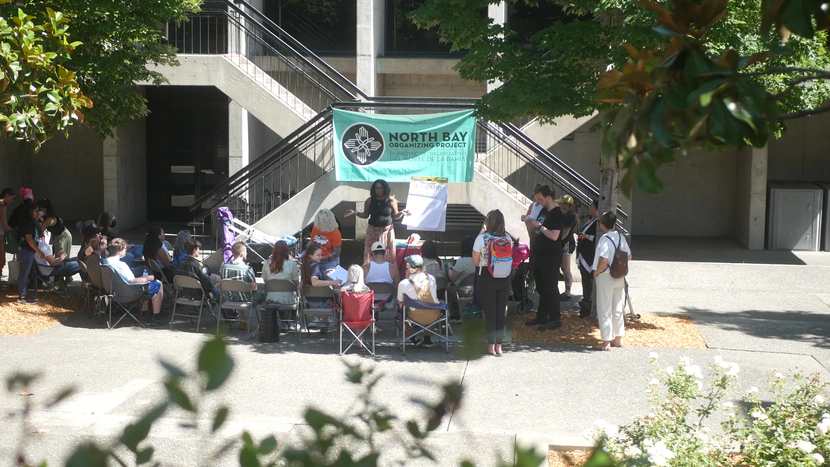
Camille Escovedo and Macaroni – who requested their last name be withheld, are both co-chairs of NBOP’s Civil Liberties Task Force.
“I think that our rights and civil liberties right now are very use it or lose it,” said Camille Escovedo.
“Right now is an absolutely terrible time to have a national database accessible by law enforcement and federal agencies that can track the whereabouts and habits of movement of basically anyone,” she said.
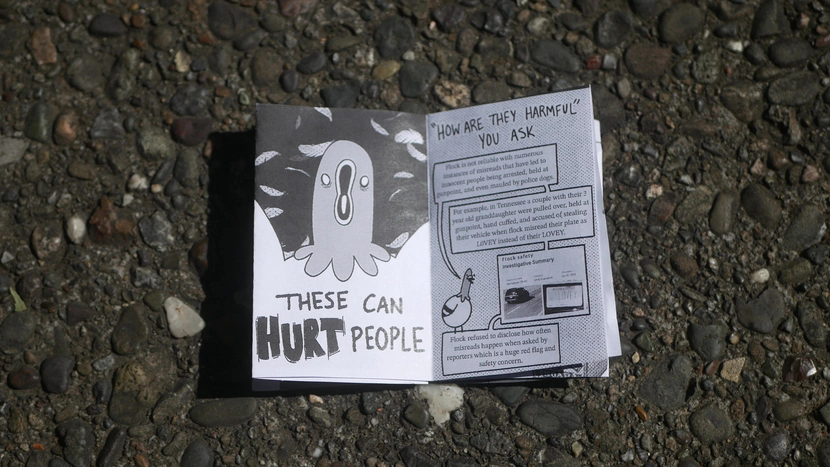
In Tennessee, a family was held at gunpoint after Flock misidentified their license plate. In Texas, police officers used Flock to search for a woman who had self administered an abortion, which is illegal in Texas.
“That pressure on local cities and law enforcement to make exceptions to their rules is going to get stronger and stronger,” said Escovedo.
Macaroni, co-chair of the Civil Liberties Task Force, said they helped make sure live-interpretation was provided during the day’s teach-in.
“Predominantly, we are English-speaking monolingual folk, and so as one of the few bilingual folk, language justice is a huge value of mine,” said Macaroni.
“I made sure Mariana was out here today to provide that interpretation, and we often canvass in different parts of Santa Rosa,” they said.
Macaroni said this was an issue that affects all communities.
“Knowing that there’s way more surveillance in the Roseland area, [we’re] trying to ensure that language justice and awareness is also being created as we’re doing this work in Sonoma County,” they said.
One worry of theirs was where funding would come from after the grants expire.
“That’s why I’m so invested to raise community awareness now, so when that moment comes of hey, it’s time to tax fund it with our own tax dollars – we actually have an informed community of what we’re signing up for. And with an informed community, there’s enough pushback to deflect – because I don’t want my tax dollars to be funding my own surveillance,” said Macaroni.
Despite California state laws prohibiting access to automated license plate reader data by out-of-state agencies, Flock data is still shared with federal agencies like ICE.
According to a report from Calmatters in June of 2025, “Law enforcement agencies across Southern California violated state law more than 100 times last month by sharing information from automated license plate readers with federal agents.”
While SRPD’s Policy states that facial recognition, people, and race are not detected by their cameras, Flock Safety’s patent documentation (US Patent US11416545B1) outlines neural network modules designed to classify human characteristics including race, gender, height, weight and clothing.
And while SRPD says it doesn’t hand information to ICE – Santa Rosa police share their Flock automated license plate reader database with over 300 California police and sheriff’s departments, where policy per department varies.
According to the American Civil Liberties Union, “Flock sells their cloud-connected cameras to police departments and private customers across the nation, pulls the license plate readings they collect into their own servers, and allows police to do nationwide searches of the resulting database, giving even the smallest-town police chief access to an enormously powerful driver-surveillance tool.”
Stephanie Locey is a community organizer with NBOP’s Civil Liberties Task Force. She helped lead the day’s teach-in, answering questions from community members.
“I am worried that this private company can’t be trusted, and that despite the fact that SRPD owns the data on paper, Flock still owns the system that it lives in and can access it,” said Stephanie Locey, “And I worry where it could go and what it could be used for.”
Locey said this was her first time leading or speaking at any community event.
“I felt pretty energized by seeing people that I had just a week prior from canvassing in attendance,” she said.
While she said Tuesday’s hot temperatures during the teach-in were a bummer, it didn’t stop her from showing up.
“’I’m worried about what [Flock cameras] will become. I’m worried about firmware updates. I’m worried about hostile federal legislation that our police will be forced to enforce if given warrants, they can’t help but comply with,” she said.
She also said Santa Rosa isn’t the only community standing up to Flock and similar technologies.
“We see a lot of momentum around this issue. We see other cities and counties that are choosing not to renew contracts with Flock. This is an actionable thing that we can come together as a community on,” said Locey.
“I feel like in a time when so many other things feel untouchable, this is something that we can actually tangibly work on as a community and change together.”