
Santa Rosa residents aren’t giving up on their efforts to ditch Flock Safety.
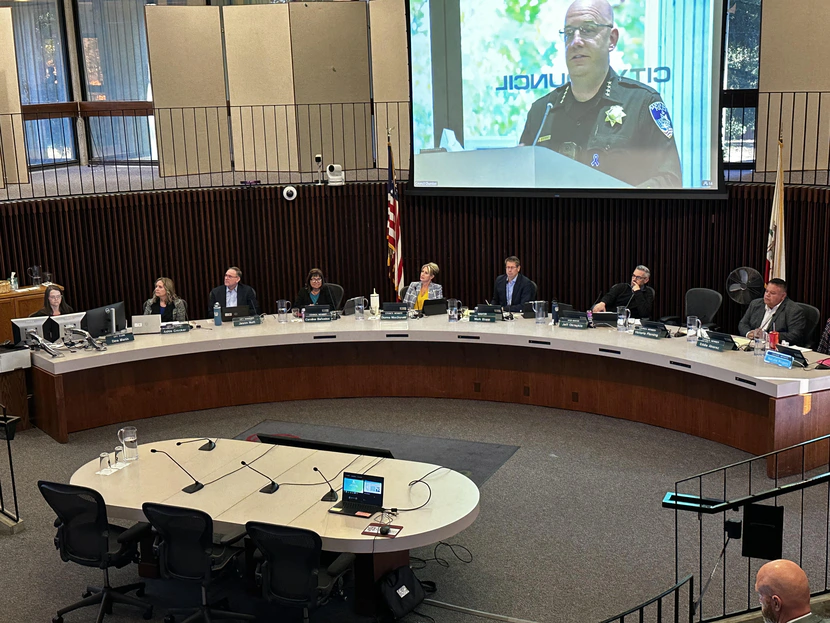
Over ten community members voiced their concerns over Santa Rosa’s use of Flock ALPR technologies during public comment at Santa Rosa’s city hall meeting on Tuesday, Oct. 13.
After public comment, Council member Eddie Alvarez proposed a motion for a community study session on Flock cameras to address the concerns of the community members.
Council member Natalie Rogers called the motion premature, and said that the city’s Flock contracts won’t be expiring for a while. Council member Fleming said this meeting “couldn’t happen soon enough”, and expressed her support for the motion. Mayor Stapp said that the City Council will vote on whether or not to pass the motion on October 27
Many speeches during public comment received positive cheers and applause from the audience. About halfway through, Mayor Stapp said the cheering had to stop after every speech or he would cut off public comment entirely. Audience members adapted to silently waving their hands or snapping in support of speeches afterwards.
Joy Ayodele is a Task Force Organizer for NBOP. She said that their initial mistrust was not with the Santa Rosa City Council, but the company Flock Safety.
“Since January, over 160 cities have ended their contracts with the Flock Safety company, 24 of which are in California. This tells me that there are in fact local elected officials that are listening to their constituents, and I hope that you will do the same,” Ayodele said.
After many months of organizing and showing up to City Council meetings and other community events, members from NBOP said they feel they are being ignored by the very people meant to serve them.
Ayodele closed remarks by mentioning that earlier this month, a federal judge ruled that a sheriff’s deputy had violated the Fourth Amendment by searching a month’s worth of local locations without a warrant – bringing up the concern that Flock cameras will be misused by police officers.
Cameron, also a member of NBOP’s Civil Liberties Taskforce, said Petaluma’s renewal of a Flock contract with minimal input from the community led to concerns about Santa Rosa doing the same. He said further renewals in the future would only cost the city more money.
“Since 2024, this technology has changed. The cameras that we agreed to two years ago are completely different, there’s software updates and other changes, so what we are signing up for with a new contract is so much worse than what we have now,”Cameron said in an interview.
He also said Flock is used as a loophole to get around Sonoma County’s migrant protections, which involves a non-compliance order (which means ICE can’t use county buildings or facilities for their operations), but with Flock cameras it becomes much easier for them to override those safeguards.
Another volunteer with NBOP, Sophie Norton, said that the community feels frustrated with the lack of action or acknowledgement from the Santa Rosa City Council.
“We’ve been showing up to speak on non-agendized time, which is very limiting, and not feeling like we have ample opportunity to voice our concerns that we have,” said Norton, “What we are hoping for is that they (the City Council) take it to a vote and put this on the agenda immediately, because the Flock contract is up in just a few months.”
Expressing similar worries about Petaluma silently renewing their contract, Norton does not want to see the same happen in Santa Rosa. She would like to see surveillance technology used by law enforcement be regulated, which is a point that many members of the community also shared.
After the motion was proposed, multiple members attending the meeting online and in person expressed their thanks for this motion being put forth by Council member Alvarez, and advised the City Council as a whole to do their research between now and the 27th.
Santa Rosa resident Jacob Gil urged all the Council members to vote yes on the motion for a study session, and quoted a recent decision by judge Sarah E. Hill in United States of America v. Melisa Susan Kyle.
“Freedom from persistent dragnet style surveillance while in public is not a foreign concept in our society and is a reasonable expectation that society already accepts. It becomes constitutionally problematic when law enforcement can indiscriminately and passively catalogue your whereabouts for an extended period of time, and then use that information for any purpose whenever convenient.”